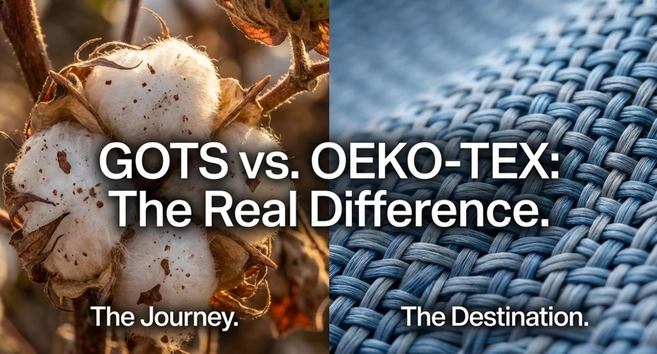
The global sustainable textiles market hit USD 66.19 billion in 2025 and is heading toward USD 180.46 billion by 2035, at 10.55% CAGR. Asia Pacific held 36% of that in 2025. Brands are being asked to prove sustainability claims now, not just make them. And two certifications keep coming up in those conversations. GOTS and OEKO-TEX. They are not interchangeable. Treating them like they are causes real problems.
In this guide, you will learn:
What Is GOTS in Fabric and What Does GOTS Certified Mean?
Is OEKO-TEX Safe and What Does It Actually Test For?
Are GOTS and OEKO-TEX the Same?
GOTS vs OEKO-TEX: What Each Certification Actually Covers
Wholesale GOTS Certified Fleece Fabric Suppliers and What to Look For
What Is GOTS in Fabric and What Does GOTS Certified Mean?
What is GOTS in fabric starts with a number. At least 70% certified organic fiber for the standard label. 95% for the higher tier. Organic means no synthetic pesticides, no synthetic fertilizers, verified by a certification body that actually checks.
But the GOTS certified meaning does not stop at the fiber. The dyes have to meet restrictions. The finishing treatments have to meet restrictions. Wastewater from processing has to be handled properly. And the social side gets audited too. Wages, working conditions, and the things that often get ignored in other certification systems.
A GOTS certified fabric claim covers a lot of ground. More than most buyers realize when they first start asking for it.
Is OEKO-TEX Safe and What Does It Actually Test For?
Is OEKO-TEX safe? Yes. Within what it measures.
OEKO-TEX Standard 100 runs finished textiles through tests for over 100 harmful substances. Heavy metals, formaldehyde, pesticide residues, pH, and color fastness. Pass those tests within the defined limits, and you get the label.
What it does not do is look at how the fabric was made or where the fiber came from. A petroleum-based synthetic with no organic content anywhere in its history can carry an OEKO-TEX label if it tests clean. That is not a problem with the certification. It just means the certification was never designed to answer those questions.
Does OEKO-TEX mean 100% cotton? No. Any fiber. Any origin. The test is about what is in the finished product.
Are GOTS and OEKO-TEX the Same?
No.
GOTS is a supply chain certification. OEKO-TEX is a product safety certification. A fabric can hold both. It can hold one. It can hold neither. Holding both is the strongest position a brand can take because it covers two completely separate things at once.
For baby products specifically, is OEKO-TEX safe as a standalone? There is a stricter OEKO-TEX product class for babies under 36 months with tighter limits than adult garments. A lot of brands pair that with GOTS-certified fabric anyway because the people buying baby products tend to want both supply chain transparency and product testing. Not one or the other.
Certifications like GOTS and OEKO-TEX matter for brands that need to back up what they say about sustainability. Manufacturers like Baoxiniao work with internationally compliant fabric standards and have been recognized among sustainable suit brands with a CDP Climate Change B rating, which covers climate governance and carbon management across their manufacturing operations.
GOTS vs OEKO-TEX: What Each Certification Actually Covers
Different questions. That is the starting point for any gots vs oeko tex comparison.
GOTS looks at the whole chain. Where the fiber came from, how it was grown, what chemicals were used in processing, and how the workers along the way were treated. The fiber has to be certified organic before anything else even gets considered. That is the baseline, and there are no workarounds.
OEKO-TEX looks at the finished product. Is it safe to wear? Does it contain harmful substances above certain limits? That is the question it answers. It does not look upstream at farming or labor. Just what ended up in the fabric.
Both are legitimate. Both are recognized globally. They are just built for completely different purposes.
Wholesale GOTS Certified Fleece Fabric Suppliers and What to Look For
The GOTS database is public. Certified facilities are listed by country and product type. Cross-referencing a supplier’s certificate against that database takes a few minutes and is worth doing before placing any order.
Transaction certificates matter too. A facility certificate confirms the factory is certified. A transaction certificate confirms that a specific shipment is covered. That distinction is what keeps the chain of custody documentation clean across a sourcing program.
Wholesale GOTS-certified fleece fabric carries a premium over conventional fabric. Organic farming, third-party auditing, compliant processing at every stage. The cost reflects all of that. For brands whose sustainability positioning is genuine rather than decorative, the premium tends to hold up.
Custom Wool Suit Manufacturing
International standard apparel manufacturing for B2B brands. We integrate premium compliant fabrics with advanced manufacturing operations to meet global sustainability and safety requirements.
Gots vs Oeko-Tex is not a competition. They cover different things. What is GOTS in fabric? A verified organic supply chain from the ground up. Is OEKO-TEX safe? Yes, for what it tests. Are they the same? No, and the difference matters when a brand needs its sustainability claims to actually stand up.
For sustainable suit ranges built with manufacturers aligned to international compliance standards, Baoxiniao is worth a conversation. Get in touch to talk through requirements.
MEN’S SUIT TRENDS 2025–2026 FALL & WINTER: WHAT BRANDS NEED TO KNOW
The 2025–2026 fall and winter season brings five key suit trends that are shaping menswear collections worldwide. As a suit manufacturer with over 25 years of production experience, Baoxiniao breaks down each trend with specific sourcing and manufacturing implications — so brand owners and retailers can translate runway direction into production-ready decisions. Luxury and Retro […]
QUIET LUXURY IN MEN’S FASHION: THE 2026 TREND REPORT
Quiet luxury men—that phrase captures more than just clothes. It’s a movement toward elegance without logos, exclusivity without flash. For buyers and industry insiders, this shift is redefining what power dressing and high-end menswear mean in 2025–26. What Is Quiet Luxury? The quiet luxury trend (aka stealth wealth, old money aesthetic men) isn’t new, but […]
HOW LONG SHOULD DRESS PANTS BE: A GUIDE TO THE TYPES OF PANT BREAK
How long should dress pants be? It’s a question that seems simple until you’re standing in front of a mirror, wondering if the hem is too high or puddling over your shoes. The answer comes down to one thing: pant break or the way your pants rest on your shoes. This guide breaks down the […]