The global apparel market hit USD 1,749.67 billion in 2025. By 2034, that number is expected to reach USD 2,307.04 billion, growing at 3.52% annually. Asia Pacific alone held 41.03% of that market last year. Flip the label on almost anything in your wardrobe right now, and there is a good chance you will find a country somewhere in that region. Vietnam, Bangladesh, China. Maybe India. Rarely anywhere else.
Where are most clothes made? Asia. That is the honest answer. But which parts, and how that production is actually distributed, matters a lot more when you are making sourcing decisions.
In this guide, you will learn:
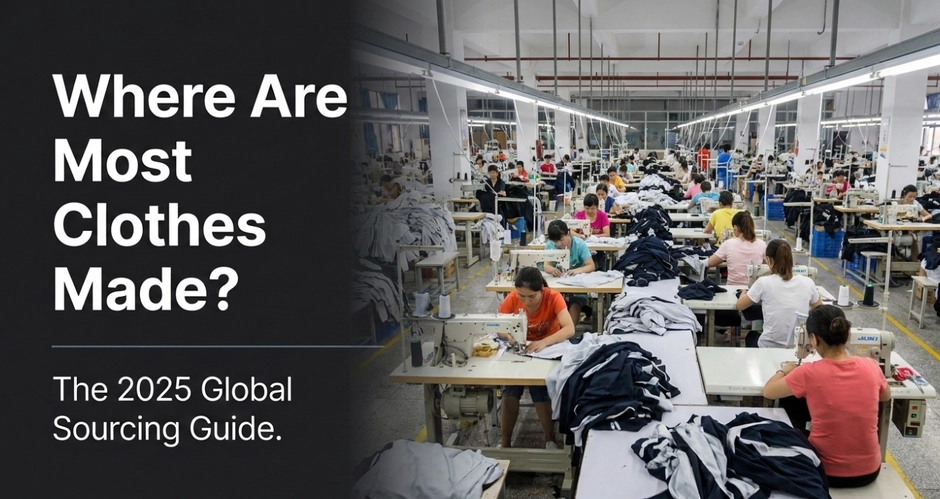
China. Still. And by a lot.
Roughly 36% of global garment exports come out of China. That share has held even as wages climbed and brands spent years publicly committing to moving production elsewhere. Most of them did not move very far. The reason is that China has built something over decades that no other garment manufacturing country has fully put together. The complete chain. Fabric mills, dyeing facilities, cutting rooms, sewing lines, testing labs, logistics networks. All of it sits close to each other, all of it developed over generations of investment and iteration.
Other countries are growing. None of them has the full stack yet.
What has shifted is what clothing made in China actually means. For a long time, the conversation was price and volume. That was it. Now, premium suiting, technical performance wear, and made-to-measure garments are coming out of China at a level that would have surprised buyers ten years ago. The manufacturers that stayed in China did not stand still. They moved up the value chain instead.
Baoxiniao is a good example of where clothing made in China sits now in terms of quality end. Over 200,000 suits are produced annually. Listed on the Shenzhen Stock Exchange. R&D running out of both Shanghai and Milan. EU-standard fabrics sourced from international mills, including Biella producers. That is not the clothing made in China that conjures images of cheap fast fashion. It is something closer to what a European manufacturer does, with a cost structure that makes large-scale orders realistic for boutique buyers and enterprise clients alike.
Several garment manufacturing countries have built serious capacity. Here is where production actually sits beyond China.
The second-largest garment exporter in the world. Around 6.5% of the global apparel export share. The whole economy was essentially built around ready-made garments, and trade agreements with the EU and US reflect that history. Basics, denim, and knitwear at volume. If you are sourcing those categories, Bangladesh is probably already in the conversation.
Fastest growing of all the major garment manufacturing countries over the past decade. A lot of brands shifted production there when China’s labor costs kept climbing. Government investment in textile infrastructure has been consistent, and trade agreements have helped open doors. Mid-range and performance apparel is where Vietnam tends to show up most in sourcing discussions.
Enormous textile capacity, especially in cotton. The finished garment export side has been slower to develop because manufacturing is more fragmented compared to China or Bangladesh. That is changing. Government investment schemes are pushing factories to scale up and the export figures are starting to reflect it.
Neither of these garment manufacturing countries is competing on price. They compete on speed and proximity to Europe. Shorter lead times, easier quality oversight, and lower shipping costs to European distribution centers. For brands that need fast turnaround on seasonal orders, the unit cost premium is often worth it.
Both have found their niches. Cambodia exports heavily to the EU under preferential trade terms, mostly in basics and casual wear. Indonesia has strong production in sportswear and outdoor apparel. Neither is close to China in scale, but both matter depending on what category you are buying in.
Asia Pacific held 41.03% of the global apparel market in 2025. Add up China, Bangladesh, Vietnam, India, Cambodia, Pakistan, and Indonesia together, and you are somewhere between 60% and 70% of finished garment production worldwide, depending on how you measure it.
That is not changing quickly. The raw materials, the spinning, the weaving, the dyeing, and the assembly are all concentrated in the same regions. Building that supply chain somewhere else from scratch takes decades. That is the real reason reshoring efforts in the US and Europe have moved so slowly despite years of political pressure and brand commitments.
Honest answer: It depends on what you are buying.
For suiting fabric, Italy. The mills around Biella produce wool cloth that sets the global standard and has done so for generations. For finished bespoke suits, Savile Row and the tailoring houses of Naples and Milan are still the reference point most of the industry measures against.
For volume, customization at scale, and value across premium garments, the answer to where clothes are manufactured most efficiently is China. Which country makes the most clothes across the widest range of complexity and price points? China, and it is genuinely not close.
Baoxiniao sits right where those two things meet. Their C2M system builds individually patterned suits across more than 10,000 design configurations. EU-standard fabrics, one-person-one-pattern accuracy, logo embroidery, full ODM capability across enterprise orders. For buyers who have assumed that clothing made in China means compromising on finish, Baoxiniao is the kind of manufacturer that changes that assumption. The garment manufacturing countries of Europe charge significantly more for something comparable in quality. Sometimes that premium is justified. Often it is not.
Where are most clothes made? Asia, with China leading all garment manufacturing countries by a margin that other countries are slowly closing but have not yet closed. Which country makes the most clothes? China accounts for around 36% of global garment exports, with Bangladesh and Vietnam growing steadily behind it.
Where are clothes manufactured for premium suiting at volume? Increasingly China. Baoxiniao is a direct example of what clothing made in China looks like when manufacturing scale meets real customization capability and Italian fabrics sourcing.
Get in touch to talk through what Baoxiniao can do for your sourcing program.
The 2025–2026 fall and winter season brings five key suit trends that are shaping menswear collections worldwide. As a suit manufacturer with over 25 years of production experience, Baoxiniao breaks down each trend with specific sourcing and manufacturing implications — so brand owners and retailers can translate runway direction into production-ready decisions. Luxury and Retro […]

Quiet luxury men—that phrase captures more than just clothes. It’s a movement toward elegance without logos, exclusivity without flash. For buyers and industry insiders, this shift is redefining what power dressing and high-end menswear mean in 2025–26. What Is Quiet Luxury? The quiet luxury trend (aka stealth wealth, old money aesthetic men) isn’t new, but […]

How long should dress pants be? It’s a question that seems simple until you’re standing in front of a mirror, wondering if the hem is too high or puddling over your shoes. The answer comes down to one thing: pant break or the way your pants rest on your shoes. This guide breaks down the […]
ADDRESS: BAOXINIAO OFFICE BUILDING, BAOXINIAO INDUSTRIAL PARK, YONGJIA, ZHEJIANG